

By Dr. Maggie McInnes | The Wellness Tribe | Denver, CO
Here’s a number that should give you pause: the average American now spends over 7 hours a day looking at screens. Phones, laptops, tablets, monitors — we are a species that has fundamentally reorganized our physical existence around small glowing rectangles, and our spines are paying the price.
If you’ve noticed that your neck and upper back feel perpetually tight, that you have more headaches than you used to, that your shoulders have started creeping up toward your ears as a default setting, or that you catch yourself slumped in a way that would have horrified your grandmother — you’re not imagining it. You’re experiencing what happens when a body built for movement, variety, and three-dimensional engagement spends its days folded around a screen.
The good news: this is understandable, it’s reversible, and there’s a lot you can do about it — starting today.
What “Tech Neck” Actually Is
“Tech neck” isn’t just a catchy phrase. It describes a very real biomechanical phenomenon with measurable effects on the spine.
When you’re looking at a phone held at lap or chest height, your head is tilted forward. This might not sound like a big deal — but consider the physics. The average adult head weighs 10–12 pounds in a neutral, balanced position. For every inch it moves forward, the effective load on the cervical spine increases dramatically. At a 45-degree forward tilt, the force on the neck is equivalent to carrying a 49-pound weight. At 60 degrees — the angle many of us adopt while scrolling — it jumps to about 60 pounds.
Your cervical spine was not designed to manage that load for hours at a time.
Over time, the result is predictable: the muscles at the back of the neck and upper back become chronically fatigued and overloaded. The muscles at the front of the neck and chest shorten and tighten. The natural cervical curve (the gentle forward curve that should be present in your neck) begins to flatten or reverse. Vertebrae shift. Discs compress. Nerves get irritated. And subluxations develop that affect not just local pain — but the neurological function of everything those nerves govern.
The Downstream Effects Nobody Talks About
Most people know that bad posture causes neck pain and headaches. But the effects of chronic forward head posture extend well beyond discomfort in the neck and shoulders.
Breathing: Forward head posture compresses the chest and restricts the movement of the rib cage, reducing lung capacity. Shallow, restricted breathing keeps the nervous system in a mild state of stress activation — which means your posture is literally affecting your mood and anxiety levels.
Digestion: The vagus nerve — which governs digestion among many other things — passes directly through the cervical spine. Compression and tension in the cervical region can impair vagal function, which may contribute to sluggish digestion, reflux, and bloating.
Energy levels: Chronic muscular tension is metabolically expensive. Your body is burning energy just to hold itself in a position it wasn’t designed for. Many people notice a significant improvement in energy when they address postural patterns — not because anything magical happened, but because their body stopped fighting itself.
Mood and mental clarity: Research has shown that posture affects mood — not just metaphorically but physiologically. Upright posture is associated with greater confidence, more positive affect, and better cognitive function. Slumped posture is associated with increased depressive symptoms and fatigue. Your posture is quite literally shaping how you experience yourself.
Neurological function: This is the big one from a chiropractic standpoint. The cervical spine houses nerves that affect the brainstem, the autonomic nervous system, and every function of the body below the neck. Chronic cervical subluxations from tech neck aren’t just a pain problem — they’re a neurological interference problem.
What’s Happening in Kids
We’d be remiss not to mention children here, because the long-term consequences of early screen exposure on developing spines are genuinely concerning.
The cervical spine in children is still developing. The musculature is less robust. And children are, if anything, spending even more time in screen-forward postures than adults — bent over tablets, gaming devices, and phones for hours every day.
We’re seeing younger and younger patients with cervical and thoracic changes that used to be associated with middle-aged adults. Forward head posture, loss of cervical curve, and upper thoracic hyperkyphosis (the “hunchback” rounding of the upper back) are increasingly common in adolescents and even young children.
This matters beyond posture and pain. A developing spine that sets into dysfunctional patterns carries those patterns forward into adulthood — and the neurological effects of chronic cervical subluxation during a period of rapid brain and nervous system development are not trivial.
If you have children who spend significant time on screens, regular chiropractic assessment is genuinely worth considering — not as an alarm bell, but as a proactive investment in their developing nervous systems.
What You Can Do: Practical Postural Strategies
The solution to tech neck isn’t to throw your phone into the Platte River (tempting as that sometimes sounds). It’s to make intentional changes to how you use technology and how you support your body through the demands of modern life.
Raise your screens. The single most impactful change most people can make is bringing their phone or monitor up to eye level. This eliminates the forward head tilt that drives most tech neck damage. Invest in a phone stand, a monitor riser, or a laptop stand — your spine will thank you.
Take movement breaks. Every 30–45 minutes, stand up, move, look at something in the distance, and reset your posture. Set a timer if you need to. Even 2–3 minutes of movement breaks the cycle of static loading on the spine.
Strengthen your deep neck flexors. The deep muscles at the front of your neck are often weak in people with forward head posture, while the muscles at the back are chronically overloaded. Simple chin tuck exercises — gently drawing your chin back to create length in the back of the neck — can begin to rebalance this pattern.
Open your chest. Doorway stretches, chest openers, and thoracic extension over a rolled towel or foam roller counteract the forward rounding that screen time promotes. Even a few minutes daily makes a meaningful difference.
Be mindful of your sleep position. Many people undo the work of postural correction during the day by sleeping with too many pillows or in a position that compresses the cervical spine. A single supportive pillow that keeps your neck in a neutral position is ideal for most people.
The Chiropractic Piece
All of the strategies above are valuable — and they work significantly better when the spine is in proper alignment.
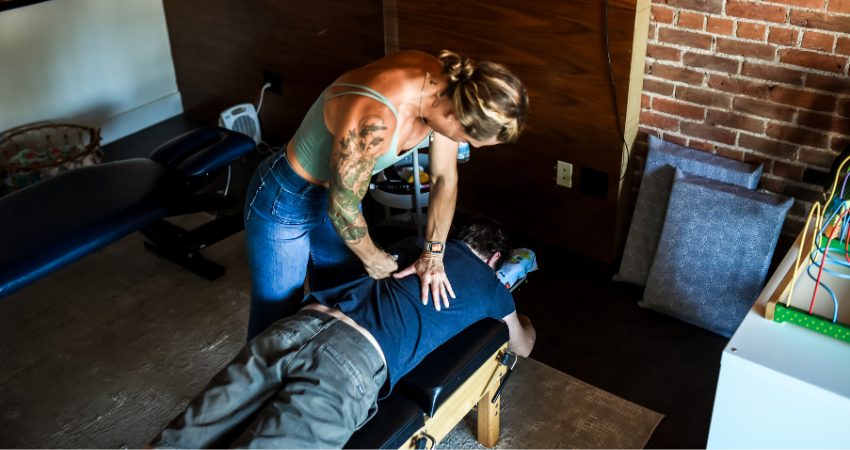
When chronic forward head posture has created subluxations in the cervical and thoracic spine, those misalignments don’t self-correct with exercise and awareness alone. The joints need to be specifically mobilized and realigned. The nervous system needs the interference removed. And the surrounding muscles and ligaments — which have adapted to the dysfunctional pattern over months or years — need support in finding a new normal.
At The Wellness Tribe, we see tech neck in almost every age group — from teenagers whose cervical curves are already compromising to adults who’ve been “getting by” with chronic neck tension for years. In every case, our approach is the same: assess the full picture, address the subluxations specifically and gently, support the patient with postural education, and work together toward a spine that functions the way it was designed to.
Because your spine is not just structural support. It’s the housing for your spinal cord — the primary pathway of your nervous system. How you care for it shapes how you feel, how you function, and how you age.
You don’t have to live with a tight neck and a foggy head as the price of participation in modern life. There’s another way.
Come find your tribe.
About The Wellness Tribe — Denver Chiropractor for Posture and Tech Neck
The Wellness Tribe is a vitalistic, holistic chiropractic practice serving Denver and the surrounding communities. Founded by Dr. Maggie McInnes, we specialize in prenatal and postnatal chiropractic, pediatric chiropractic, and whole-family wellness care. We are proud to serve the Platt Park, Washington Park, and South Pearl Street neighborhoods and beyond.
Visit Us in Denver
619 E. Jewell Ave., Denver, CO 80210